



What Comes After Carbon: Building Resiliency Out of Dependency

The CEO of a mid‑sized manufacturing company thought he finally had a handle on his biggest environmental risks.
For the past three years, the company had been knee‑deep in its carbon work. Investor pressure, new disclosure rules, and customer expectations had pushed them to map their Scope 1 and 2 emissions, model pathways, upgrade equipment, and build the beginnings of a decarbonization strategy. There was still plenty left to do, but at least the terrain felt familiar: energy, efficiency, electrification, renewables. They had a roadmap, metrics, and momentum.
But as he reviewed a briefing for an upcoming board meeting, something unsettled him. Despite all the attention, the regulation, the capital that climate was receiving, it wasn’t the risk that kept him up at night anymore.
Water was.
His company depended entirely on consistent access to clean water for their production process. The facility used roughly 1 million gallons per day for cooling, cleaning, and as an input into their primary product. And the watershed they drew from was increasingly stressed.
Droughts were becoming more frequent. Competing demands from agriculture and municipal systems were growing. Water rights were subject to tightening regulation. And none of this was getting better.
This wasn’t an environmental issue.
It was an existential business risk.
What happened next is a textbook example of how understanding environmental dependencies can transform vulnerability into competitive advantage.
The Awakening: Mapping What Actually Matters
The company started with something deceptively simple: a comprehensive mapping of their environmental dependencies.
Not their impacts. Their dependencies.
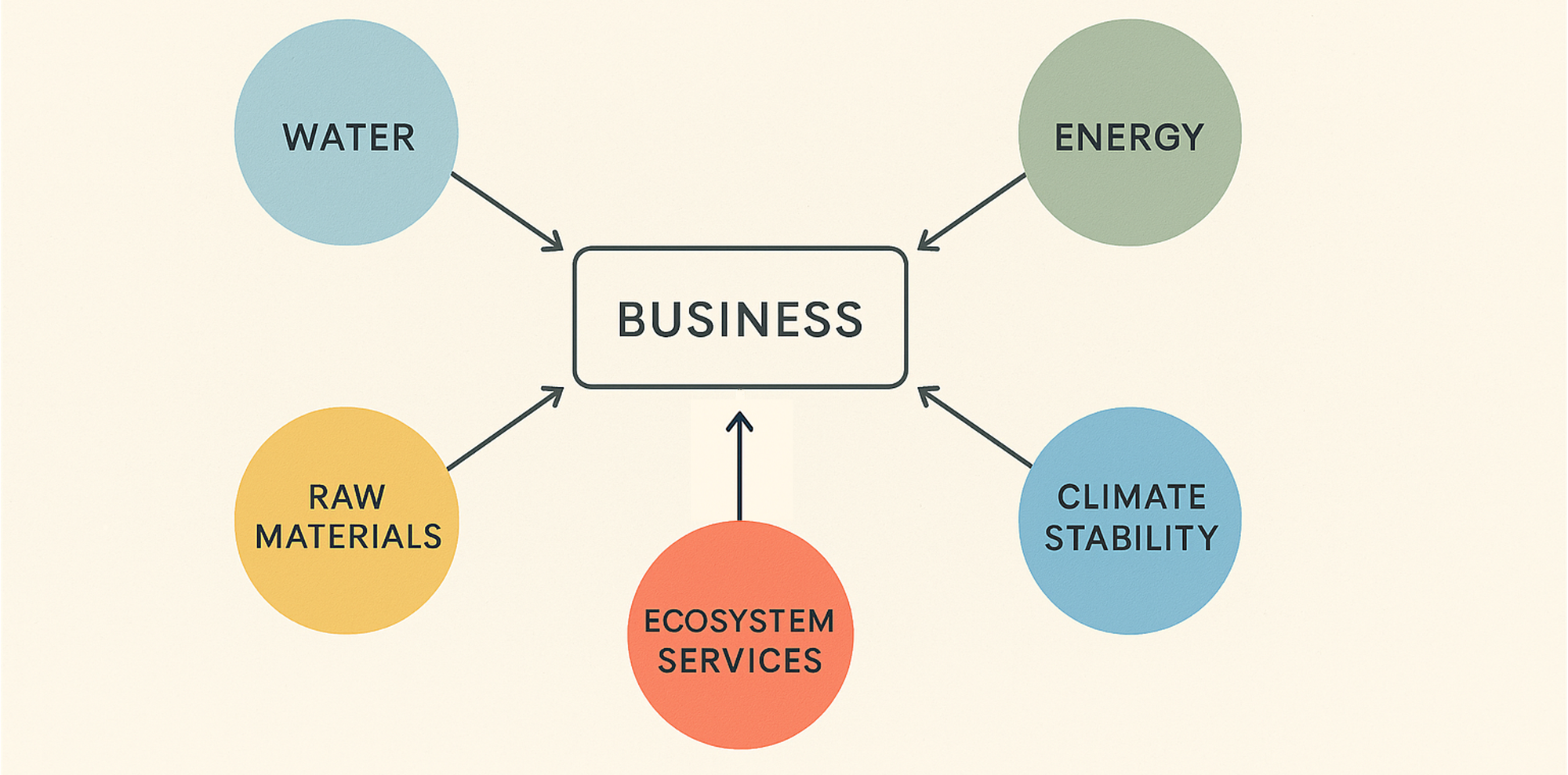
What natural systems did their business actually rely on? Water, obviously. But also: stable regional climate for consistent operations, healthy ecosystems that filtered and purified water upstream, soil stability around their facilities, even local biodiversity that indicated overall ecosystem health.
They quantified these dependencies wherever possible. What would a 20% reduction in water availability cost them? What about a 30-day operational shutdown due to water restrictions? What would relocating the facility cost if the watershed became completely unreliable?
The numbers were sobering. A sustained water shortage could cost them $2-4 million per month in lost production. Relocation would run $50-100 million and take 18-24 months. And insurance didn't cover most of these scenarios.
They had built a $150 million business on an assumption that was increasingly fragile: that clean water would always be available when they needed it.
The Shift: From Risk to Opportunity
Here's where most companies stop. They've identified the risk, they've quantified it, and now they focus on mitigation: emergency reserves, alternative suppliers, contingency plans.
They started measuring their water use comprehensively. Not just total gallons, but flow rates, temperatures, quality requirements, and waste patterns throughout their entire process.
And they discovered something interesting.
They were using far more water than they actually needed. Legacy processes designed 20 years earlier when water seemed infinite. Equipment that hadn't been optimized. Cooling systems running at unnecessary volumes. Cleaning protocols that were more thorough than required.
In some areas, they found they were using 3-4 times more water than technically necessary for the same output and quality.
The opportunity was obvious: radically reduce water dependence while cutting costs and building resilience.
The Execution: Turning Insight into Action
They launched a comprehensive water optimization initiative. Not as a sustainability project. As a strategic operations and risk management priority with full C-suite backing and capital allocation.
The program included:
Process Redesign: Engineers redesigned core manufacturing processes to minimize water use while maintaining or improving output quality. This required upfront capital investment but delivered immediate operational savings.
Equipment Upgrades: They installed closed-loop cooling systems, advanced filtration that allowed water reuse, and sensors that optimized flow in real-time based on actual needs rather than assumed requirements.
Watershed Partnership: They worked with local conservation organizations to restore wetlands and riparian zones upstream, improving natural filtration and water retention in the watershed itself. This wasn't charity; it was infrastructure investment in the natural systems they depended on.
Measurement and Management: They built water metrics into their daily operational dashboards, tracking consumption with the same rigor they tracked production output and quality metrics.
The Results: Competitive Advantage Unlocked
Eighteen months after launch, the results were remarkable:
Water use dropped 60% from 1 million gallons per day to 400,000 gallons per day, while production volume actually increased by 12%.
Operating costs fell by $1.8 million annually through reduced water acquisition, treatment, and discharge costs.
Regulatory risk decreased. When regional water restrictions were looming on the horizon, the company was already well below the thresholds while competitors struggled with forced production cuts.
Resilience increased. The company could now operate through drought conditions that would shut down competitors. This wasn't theoretical. During a severe drought, they gained market share simply by being able to maintain production when others couldn't.
But perhaps most importantly, the company fundamentally changed how it thought about environmental dependencies.

Three Principles for Replication
This approach works across industries. The specific tactics vary, but the principles are universal:
1. Map dependencies before impacts. Understand what your business relies on before worrying about what it affects. Dependencies are where your vulnerability and opportunity both live.
2. Quantify in business terms. Environmental dependencies matter when they're translated into financial risk, operational resilience, and competitive position. Make the business case clear and compelling.
3. Treat natural systems as infrastructure. You wouldn't ignore the condition of your factories or your IT systems. Natural systems deserve the same strategic attention because they're just as fundamental to your operations.