




Why every business has a stake in forest conservation

The importance of forests for the stability of the planet cannot be overstated. Over 80% of the world’s land-based species, including humans, rely on them. Forests provide critical resources like timber, food, and medicine. On a deeper level they rejuvenate, inspire, and delight us. The charismatic species that we love disappear from our future when we don’t protect them. Given the power human beings have to manipulate the world around us, we have a moral duty to protect these natural spaces that have been handed down to us from generations prior.
As a business owner, leader, or investor, you likely appreciate this sentiment. You may sympathize with the problem, recognizing that the private sector is a main driver of deforestation. But “saving forests because it’s the right thing to do” might not be enough to elicit action. You have short-term priorities, stakeholders to answer to, or investors that need to see profits next quarter, not next year.
In the current economic space, many companies are considering the value of nature in the form of cleaning up their supply chains, or reducing their public perception risks. Though these motivations and actions are undoubtedly positive, we make the argument in this article that businesses should go beyond simply cleaning up their supply chains, and look at the real reason why businesses should directly invest in ecosystems. We’ll do this by showing the real value of nature to business and giving some suggestions about how to make the most efficient impacts.
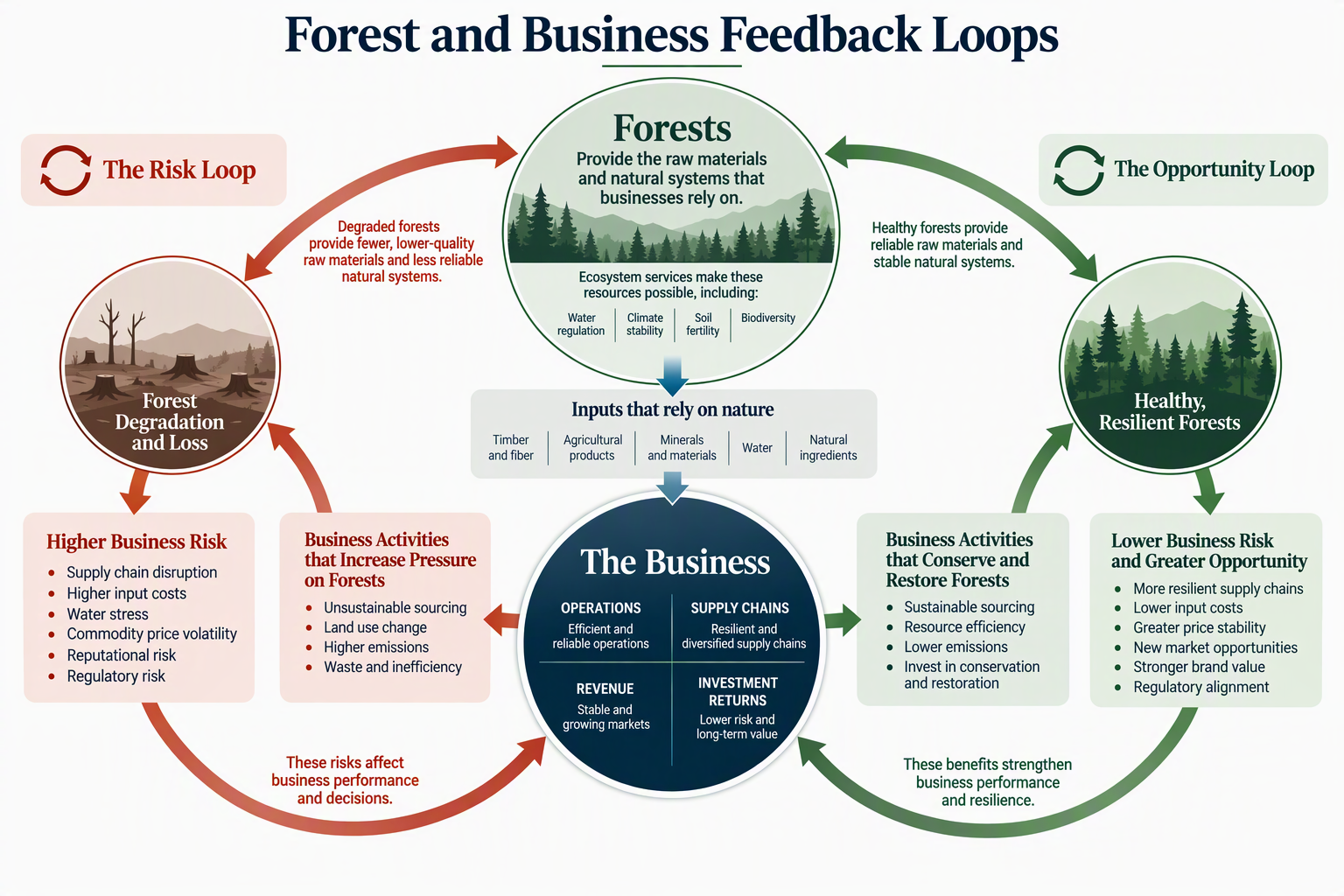
Ecosystem Services behave like an economic recession
Economies and forests behave with remarkably similar characteristics. In the economy, recessions build quietly in the background and spread through a series of linked decisions that look sensible to the individuals making them. By the time economic forecasts become reality, the thousands of individual decisions leading to a sluggish economy have already been made, and it can become much more difficult to reverse the downturn than it was to prevent it in the first place. Recessions are typically not slow, linear, and cleanly predictable events. The factors that lead to them are often much more easily understood in hindsight in the heat of the moment.
Forests behave similarly, where small, individual decisions lead to their degradation, eroding their value. Forests do an incredible amount to support us: they provide food and water, purify the air we breathe, regulate the climate we depend on, and give us space to recreate and recharge. These benefits, known as ecosystem services, are far too often treated as free, common resources that a business need not pay for. As a result, their values worldwide have declined, while our reliance on them only keeps growing. And like an economic recession, ecosystem service loss often presents itself not as a slow and linear decline, but as a rapid and dramatic unexpected loss. Ecosystems can reach tipping points, where services that seemed stable fail rapidly quickly in a manner that restoring them is extremely costly, or often impossible. On a global scale, the warning signs of these types of events are already here: In 2025, for example, 42% of global tree cover loss was not due to traditional deforestation, but to major fire outbreaks. Major fire outbreaks and forest degradation feed off of each other, since damaged forests burn more readily, making early preventative measures far cheaper than reacting to them after the fact.
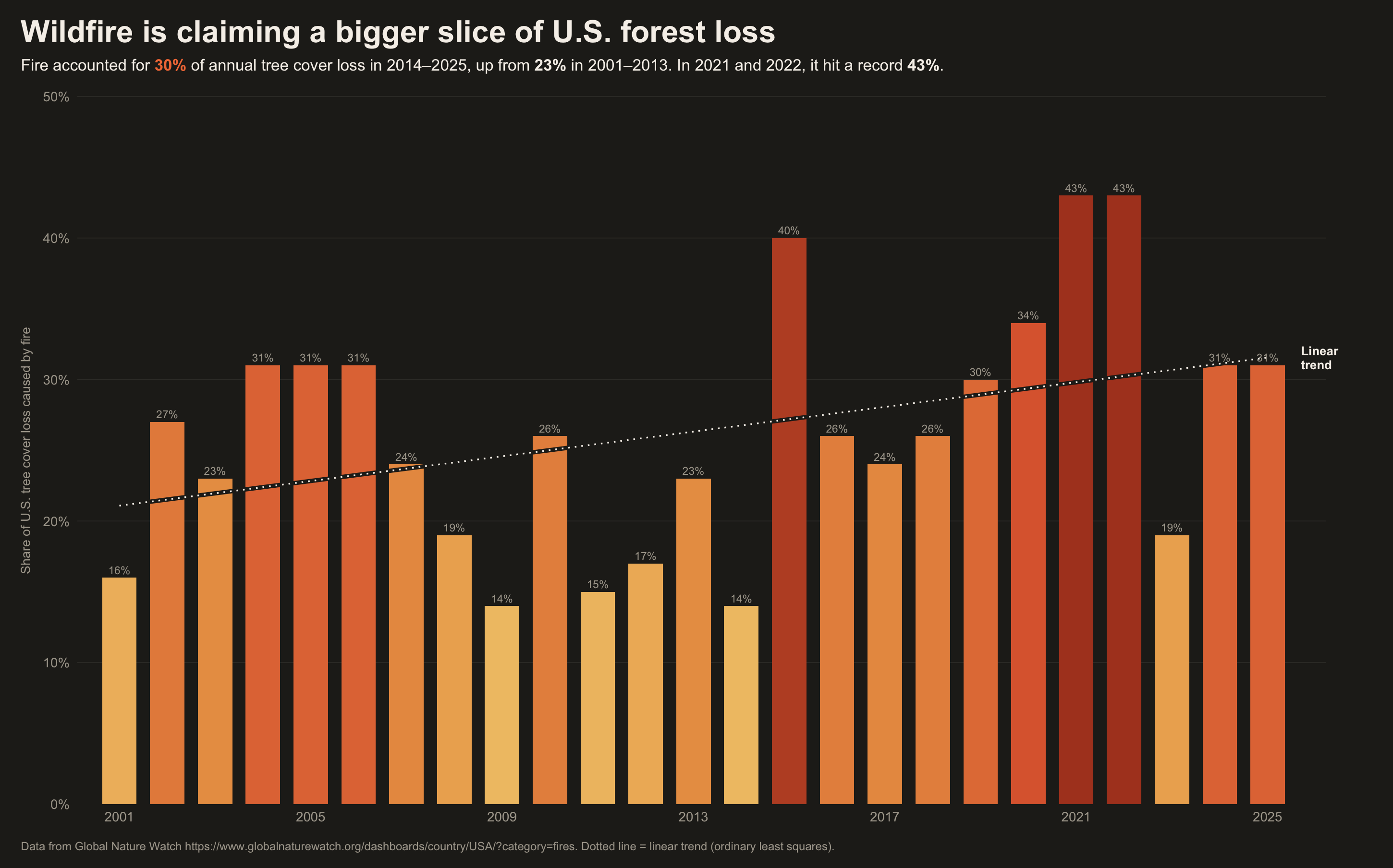
These concerning trends become more pressing when we observe just how much we depend on ecosystem services to keep our economy running. A 2020 report from the World Economic Forum (WEF) found that more than half of the world's total GDP is moderately or highly dependent on nature and the services it provides. Direct dependencies on nature can seem small for some sectors, such as digital communications, healthcare delivery, banking and capital markets, or insurance and asset management. But the narrative changes when you look upstream. The report found that a group of industries with less than 15% of their operations dependent on nature had over 50% of the gross value added in their supply chains considered highly or moderately dependent on nature. As a result, you may be more dependent on ecosystem services than you think, and you may be dependent on them in ways that aren’t so direct and obvious. In a world where supply chains are globally linked, where natural and geopolitical risks in a seemingly isolated part of the globe can have cascading effects, we should assume our dependencies on nature are as well.
Your ecosystem service dependencies likely end in forests
If you follow your nature dependencies upstream, you’ll most likely find they land in forests. Forests regulate the water cycle, stabilize soil, store carbon, and shelter the pollinators and species that so many industries quietly depend on. So what happens when those ecosystem services degrade?
A more tangible example can be seen by studying São Paulo, whose water supply relies in large part on rios voadores, or flying rivers, where winds carry massive amounts of water vapor from the Amazon Rainforest – thousands of kilometers away – to feed the cities’ reservoirs. Deforestation within the basin has been affecting these flying rivers dramatically throughout the last few decades, to the point where in January of 2015, São Paulo’s main water reservoir got as low as 5% capacity, about a month’s supply. Though poor water management and rising water demand in the region also plays a role, the decline of rios voadores, as with many climate related pressures, acts as the invisible hand that makes weathering low water years far worse. For all businesses, regardless of who is to blame for deforestation and who is not, bear immediate consequences for these droughts in the form of water rationing, disrupted operations, and rising costs for all who depended on the city’s water. Considering this, it can be much easier to understand that cleaning up your supply chains may not be enough.
These phenomena happen because ecosystem services are often undervalued in our current economic system. Unlike direct goods like lumber or harvested fish, the role that a forest plays in water regulation, air purification, or flood control does not have a market price. However, this missing market price does not mean that businesses should value them as zero. In fact, the companies that analyze their dependencies can avoid costly surprises or find new opportunities.
Take the Asia Pulp & Paper (APP) scandal of the early 2010s. APP found itself experiencing intense international backlash after investigations exposed its role in Indonesian natural forest and peatland clearcutting. APP was upstream in the supply chain of many major companies, including Staples, Office Depot, Disney, and more. For APP, the loss of major customers represented an existential commercial and reputational setback. For the companies reliant on APP, the scandal forced them to scramble to cancel or suspend their procurement contracts with APP and find stricter paper-sourcing policies. For companies supplying sustainable procurement alternatives, and the investors financing these companies, the disruption created an opportunity to capture demand from businesses seeking to reduce their exposure to deforestation.
Taking Action: Investing in Forests and Reducing your Risk
Cleaning up your supply chain may not be enough, but it’s certainly a good start. Let’s explore some ways your business can address forest loss in three general steps:
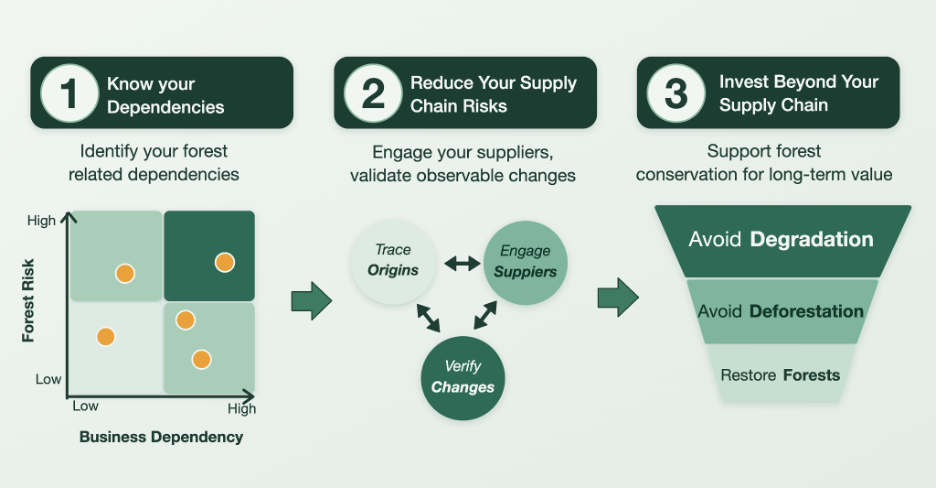
Step 1: Know your dependencies
If you are starting from scratch, it can be helpful to analyze your purchasing before engaging with suppliers. You may start by flagging products with heavy forest dependency, such as wood, paper, packaging, natural rubber, palm oil, etc. Once you have this list, you can rank these purchases by business dependency (for example, the volume of the product used) and forest risk (for example, high, medium and low). This can help turn this complex information into a priority list. Tools like the WWF Wood Risk Tool can help you address your forest-product supply chain.
Step 2: Reduce your Supply Chain Risk
Once you know where your biggest risks are, you can begin to work with your suppliers. This can come in the form of tracing forest products back to their origin, setting deforestation-free sourcing standards, and prioritizing the high-risk items on your list. This is essential work, and reduces your exposure.
This effort may involve looking beyond your immediate suppliers, taking the time to look further upstream to where your raw materials originate. Where you find major dependencies on unsustainable practices, it may be worth engaging your suppliers before immediately looking for ways to sever ties with them. As a purchaser, you have a powerful voice in encouraging your suppliers to invest in better forest management. For paper products, more sustainable investments can be in the form of increasing recycled fiber content or using alternative materials with lower deforestation pressures, such as bamboo or hemp. Reducing your supply chain risk is iterative, and it’s important to continuously engage with your suppliers to promises become measurable change.
Step 3: Invest beyond your Supply Chain
As described above, a squeaky-clean supply chain still does not remove the shared risk. This can only be done by investing in nature, by valuing the ecosystem services you rely on. This is the route to take if your sector is not a major driver of deforestation; because you share nature dependencies, you also share the risk, and you have a clear stake in investing in the solution. If you are going to take the step to invest in forests, it only makes sense that you want to make sure you produce the most impact per dollar invested. Discovering how to do this is multifaceted, but we provide some food-for-thought below, with a focus on forest ecosystems.
- Consider the tropics: Most deforestation in the present day happens in the tropics, where a whopping 95% of forest loss occurs. Some examples of major material pressures come from the beef & cattle industry (occupying 80% of deforested lands in the Amazon), palm oil (270,000 hectares deforested annually in Southeast Asia), and soybean (480,000 hectares deforested in major soy-producing tropical countries). Though conservation is important everywhere, the tropics just might be where your investments go the furthest.
- Consider the strategy: Investing in forests can take many forms, but three main investments come in the form of restoring already deforested areas, avoiding further deforestation, or avoiding human-caused forest disturbance (degradation, a topic that has received far less attention).
- Favor avoidance over restoration: Recent evidence suggests that investing in avoidance strategies (avoiding deforestation and degradation) is the more cost effective way to make an impact on global forests. Avoidance strategies were both associated with lower costs and higher benefits, but this doesn’t underscore how important forest restoration is as well. A combined effort of all three strategies makes for the most cost effective and impactful approach. But just like how waste management has a benefit hierarchy – reduce, reuse, then recycle – protecting forests may have an effective hierarchy as well – avoid degradation, avoid deforestation, and invest in restoration.
Your business has dependencies and risks associated with forests and just like a recession. The decisions you make now will drive how you respond when those risks become impacts. It’s time to understand the true value ecosystem services have on your business, and make investments to keep your dependencies on nature stable.