




Better Decisions: The Investment After Carbon Accounting


Take a business decision you make, any decision, and think about the information you use to inform it. Most decisions are based on a relatively small set of financial, operational, and strategic metrics. But what if there are important costs, benefits, risks, or opportunities hiding just outside the frame of the analysis?
This post is part of a new series, Better Decisions, where we use practical examples to illustrate how impact accounting can complement traditional analysis, helping decision-makers better understand tradeoffs, uncover hidden risks, and identify new opportunities for value creation.
Many companies hit a stage where growth and success create opportunities for new investment. Environmental and social measurement systems may already be in place, but measurement alone does not create impact.
Eventually, they reach a new question: What should we actually do?
Consider this simplified scenario: Your company manufactures consumer apparel and has found a unique position in the market. Strong sales, expanding production, and healthy profits have put you in a growth phase, and leadership is considering where to invest capital next. Leadership wants to ensure that these investments align with company core values while creating meaningful outcomes for both business and society. As a result, you plan to invest 5% of this year's profits, $1.25 million, into impact and sustainability initiatives. The challenge is determining where that money will create the greatest value.
The company has established an annual greenhouse gas inventory but is now at a decision point. After analyzing your Scope 1-3 emissions, you notice that emissions have increased 10% year-over-year. While growth explains much of the increase, leadership recognizes that continuing on the current trajectory will make its sustainability ambitions increasingly difficult to achieve.
While companies looking to take climate action could take many approaches, most next steps fall into one of these three categories:
- Investing directly in infrastructure: Installing rooftop solar to reduce the reliance on grid energy.
- Compensate for impacts you cannot yet eliminate by reducing emissions through market-based approaches: Buying carbon credits to offset company emissions.
- Creating positive impact outside the value chain: Developing a non-profit wing that builds community solar projects for underserved communities.
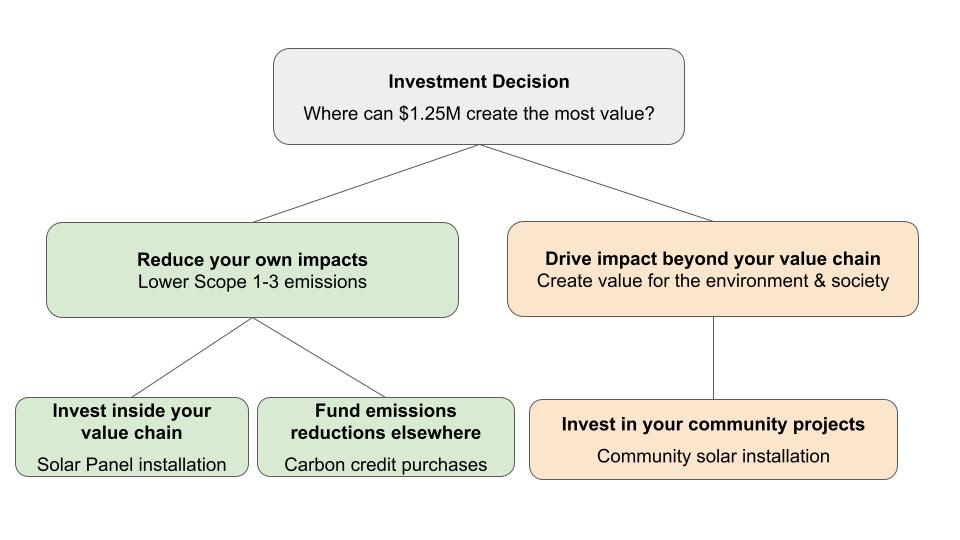
At first glance, this may feel like comparing apples and oranges. Each approach involves different teams, different stakeholders, and different business structures. Yet all three are ultimately attempts to create positive environmental and social outcomes.
1. Investing directly in infrastructure: Rooftop Solar
Business Impacts
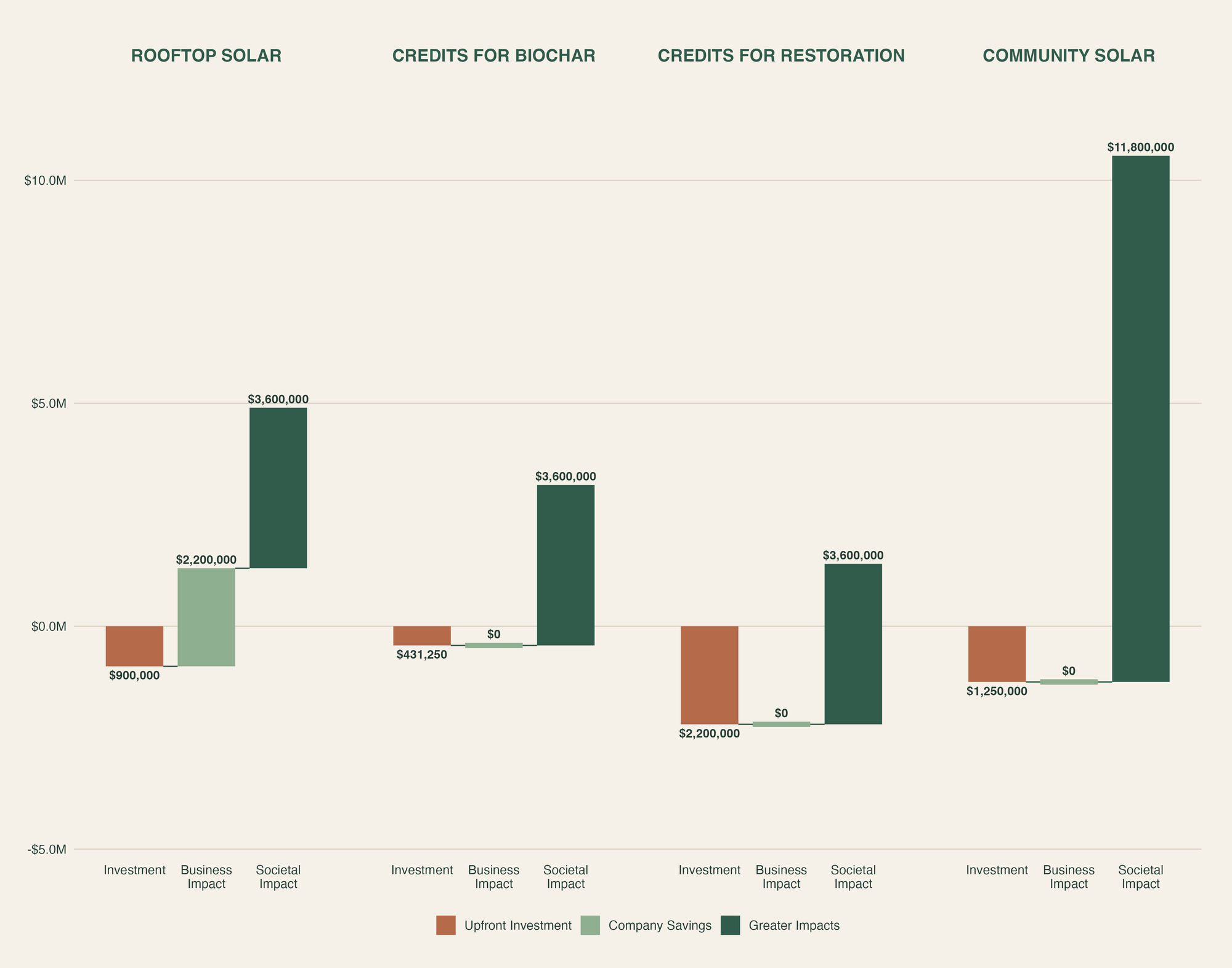
After an external solar energy analysis, you find that the solar panel installation will cost $900,000 but save approximately $89,000 in energy costs annually, before accounting for escalating energy prices and tax incentives. Even using these conservative assumptions, the system pays for itself in roughly 11 years and continues generating savings throughout its estimated 25-year lifespan.
Further, 70.4% of the local electricity grid is powered by fossil fuels. A greenhouse gas analysis finds that the project can reduce your company's Scope 2 CO₂ emissions from 575 tonnes per year to essentially zero, making a meaningful contribution toward future emissions reduction targets.
Of course, these benefits come with trade-offs. The upfront investment is substantial, the payback period is relatively long, even if the reduced operating costs are favorable. The company should be confident it intends to remain at the facility for the foreseeable future before making the investment.
Societal Impacts
You also know that the impacts of your company's CO₂ emissions extend well beyond your facility. Of course, the reason the company has a sustainability team is to reduce it’s role in driving societal impacts from climate change. Each ton of CO₂ emitted contributes to global challenges including increased death from heat exposure (35,000 in Europe this year!), loss of agricultural production, and damages to vital infrastructure. These impacts are not disconnected from your business. They affect your employees, customers, investors, and communities around the world.
Using the social cost of carbon, which estimates the societal impacts from climate change, the impact of each tonne of CO₂ emissions can be translated into ~$258 dollars of impact. Using this present-day figure and projecting impacts forward, we estimate that the reduction of 575 tonnes of CO₂ per year over the 25 year lifespan of the project will save $3.6 million in damages to society and the environment.
Viewed through this lens, the solar project creates value in two ways: lower operating costs for the business and reduced costs borne by society.
2. Compensate for impacts you cannot yet eliminate by reducing emissions through market-based approaches: Carbon Credits
Business Impacts
Another widely used option for addressing corporate emissions is the purchase of carbon credits. Carbon credits are certificates intended to represent one metric ton of carbon dioxide removed from or prevented from entering the atmosphere. While this post won’t go into the nuance of carbon credits, they are a widely used option because they are relatively cheap, the finances to purchase credits can be mobilized relatively quickly, and they are immediately scalable.
Carbon credits can also support a wide range of projects that might have been difficult for your company to implement otherwise including forest conservation, habitat restoration, biochar production, and engineered carbon removal technologies. Many projects can go for $10 - $30 per tonne of CO₂ though some might also cost well over $1,000 per tonne.
However, affordability comes with an important tradeoff: certainty. The quality of carbon credit projects varies widely, and some projects have been criticized for overstating their climate benefits or failing to guarantee long-term carbon storage. As a result, many sustainability practitioners recommend reducing direct emissions first and using carbon credits to address residual emissions that cannot yet be eliminated.
Carbon credits can still act as a valuable component of the solution to our climate change woes. But the burden of due diligence and research on what carbon projects to invest in and which projects will end up being effective is far too often left up to the discretion of the buyer themself.
After careful research and consideration, your company will choose one of two types of credits:
Table 1: Carbon Credit Comparison
*Theoretical example with estimated values; actual quantification of direct projects may yield different results.
Societal Impacts
If a carbon credit project performs as advertised, the societal benefits can be substantial. Every tonne of CO₂ removed or avoided reduces future climate-related damages, just as reducing emissions within your own operations would.
In the case of the biochar project, offsetting 575 tonnes of CO₂ annually would theoretically create roughly the same climate benefit as the rooftop solar installation: approximately $3.6 million in avoided social and environmental damages over 25 years.
The mangrove restoration project may produce similar climate benefits while also supporting local employment, biodiversity, ecosystem restoration, and coastal resilience. These co-benefits can create value that extends beyond carbon removal alone. While these co-benefits are difficult to measure directly, considering them in the decision making should be a key step of your process.
The challenge is that these outcomes depend on project performance. Unlike the rooftop solar project, where emissions reductions can be measured directly, carbon credit investments require confidence that the reductions or removals occur as claimed and remain durable over time. This uncertainty may be mitigated with more expensive credits but requires increased due diligence.
3. Creating positive impact outside the value chain: Non-profit Community Solar
Business Impacts
Unlike the first two options, investing in a community solar project will not affect your company’s Scope 1, 2, or 3 emissions. Your company will produce the same amount of upstream and downstream emissions and its carbon footprint will remain unchanged.
As a result, this investment does not contribute directly toward corporate emissions reduction targets and generates no operational savings for the business. There may be reputational or marketing financial benefits though it is unclear the extent to which those might occur. Unlike a rooftop solar installation, there are no lower electricity bills. Unlike carbon credits, there is no claim that company emissions have been offset elsewhere.
From a traditional business and carbon accounting perspective, the primary return on this investment is not internal performance improvement. Instead, it is the creation of positive impact beyond the company's value chain.
Societal Impacts
Because of the community focus, the societal and environmental impacts of this project are substantial.
After an initial analysis, your company finds that if you invested $1.25 million, your system would produce 1.3 million Kwh per year, enough annual energy to power ~127 homes. With a current rate of ~$0.12/Kwh, your investment is expected to save the community a total of ~$160,000 in energy costs per year. After accounting for panel degradation over the expected 25 year lifespan of the solar project, this translates to a total of $3.6 million in energy bill savings for low-income communities.
The project also produces measurable climate benefits. Although the resulting emissions reductions cannot be counted toward the company's own emissions reduction targets, the electricity generated still displaces fossil-fuel-based power generation. Using the social cost of carbon applied earlier, you determine that the community solar investment will avoid $8.2 million in damages to society and the environment.
Unlike the rooftop solar investment, the majority of the value created by this project accrues to people outside the company. This makes it a useful example of how investments beyond the value chain can sometimes generate larger overall societal returns than investments focused solely on reducing a company's own footprint.
Making Better Decisions
Companies are increasingly making decisions between investments that create very different forms of value. Traditional financial analysis tells us which investments generate returns for the business. Carbon accounting helps us understand where impacts occur within our value chain and where emissions reductions can be achieved.
Table 2: Comparing Apples to...Apples
$8.2 Million in energy bill savings
*Theoretical example with estimated values; actual quantification of direct projects may yield different results.
Looking only through a traditional financial lense, the rooftop solar installation appears to be the strongest option. It reduces the company's own emissions, contributes toward future climate goals, and generates approximately $2.2 million in energy savings over its lifetime.
But for a company investing $1.25 million from a position of growth and profitability, the decision may not be quite so straightforward. The difference between generating some additional operational savings and generating none at all may be relatively small compared to the broader question: where can this capital create the most overall value?
*Theoretical example with estimated values; actual quantification of direct projects may yield different results.
This is where impact accounting adds another dimension to the decision. Rather than focusing exclusively on value captured by the company, impact accounting attempts to measure value created for society and the environment as well. It allows investments with very different outcomes to be evaluated within a shared framework.
In this simplified example, the community solar project creates the greatest societal return per dollar invested. However, that does not automatically make it the "best" choice. Another company may place greater emphasis on reducing its own footprint, strengthening operational resilience, achieving emissions reduction targets, or demonstrating leadership within its value chain. In those cases, rooftop solar may still be the preferred option or certain carbon credit options may be preferred. Real-world decisions often involve additional considerations such as biodiversity, water use, workforce impacts, economic development, risk, brand value, equity, and long-term strategic objectives. As more dimensions are added to the analysis, the picture becomes more nuanced and the discussion becomes richer.
The purpose of impact accounting is not to produce a single correct answer. It is to make tradeoffs visible. Once decision-makers can see the financial, environmental, and social consequences of each option side-by-side, they can make choices that are more intentional and more closely aligned with their organization's goals.
Rather than asking:
Which option is best for our business?
It may be more useful to ask:
- Where can our capital create the greatest overall value?
- What types of impacts matter most to our stakeholders and long-term strategy?
- How much value should accrue to our company versus society more broadly?
- Should we prioritize reducing impacts within our own operations, supporting solutions beyond our value chain, or some combination of both?
There is no universally "best" sustainability investment. Every option in this example creates value, but it creates that value in different places and for different stakeholders.