




Better Decisions: Data Center Location


Take a business decision you make, any decision, and think about the information you use to inform it. Most decisions are based on a relatively small set of financial, operational, and strategic metrics. But what if there are important costs, benefits, risks, or opportunities hiding just outside the frame of the analysis?
This post is part of a new series, Better Decisions, where we use practical examples to illustrate how impact accounting can complement traditional analysis, helping decision-makers better understand tradeoffs, uncover hidden risks, and identify new opportunities for value creation.
Data centers have become one of the most talked-about infrastructure investments in recent years.
The rapid growth of AI, cloud computing, and digital services has triggered a wave of new data center development across the United States. At the same time, these projects have generated growing discussion around electricity demand, water consumption, and impacts on local communities and ecosystems.
Supporters emphasize the economic value and digital infrastructure these facilities provide. Critics point to concerns around energy use, water scarcity, land conversion, and long-term sustainability. The reality is that both perspectives have merit.
Perhaps the core challenge is that the potential value or impact happen in different languages and arenas. Value is in dollars and impacts in GHG emissions. But that is where impact accounting can start new conversations around how to make better decisions.
The Decision: Where to put a data center?
Consider the following scenario. After screening multiple locations, your company narrows the search for a new data center to three candidate sites.
Table 1: Construction Cost Comparison
At first glance, Cleveland appears to be the obvious choice. It has the lowest construction cost and therefore the strongest traditional business case.
But most executives would agree that construction costs don't tell the whole story.
Real estate prices capture what buyers and sellers agree to pay. Construction budgets capture labor, materials, equipment, and contractor costs. Yet neither reflects many of the broader impacts created by the project itself.
For a data center, we can think of those concerns raised at the beginning as material externalities to be measured including:
- Greenhouse Gas Emissions
The electricity required to operate a data center can create significant emissions depending on the carbon intensity of the local electric grid. - Water Consumption
Data centers require substantial cooling. Water use can have very different implications depending on local water scarcity and competing demands for resources. - Loss of Ecosystem Services
Developing a site may eliminate natural benefits provided by ecosystems, including carbon storage, flood mitigation, habitat, recreation, pollination, and water regulation.
The challenge is that these impacts are measured using entirely different units. Water is measured in liters, emissions in tonnes, and ecosystem impacts in hectares.
By translating environmental outcomes into monetary values, impact accounting allows decision-makers to evaluate impacts alongside traditional financial costs, creating a more complete picture of value creation, value erosion, risk, and opportunity.
While these impacts are not necessarily costs borne directly by the business today, they often highlight dependencies and risks that can become financially material over time through regulation, resource constraints, changing stakeholder expectations, or disruptions to the communities and ecosystems that businesses rely upon.
Looking Beyond Construction Costs
For this example, we estimated the environmental implications of each location over a ten-year period.
Table 2: Physical Operating Assumptions
Looking only at these operating metrics, Cleveland again appears attractive. It uses less energy, consumes less water, and has the lowest construction cost.
However, these metrics still lack important context.
Not all electricity grids have the same emissions profile. Not all water use creates the same level of impact. And not all land provides the same ecosystem value. To compare these factors on a common basis, we converted them into estimated monetary impacts.
The Translation: Business-Relevant Terms
Using impact accounting frameworks we can immediately convert the table above into a new language, where the tradeoffs are comparable, a form of profit & loss that considers environmental impact.
Table 3: Estimated 10-Year Environmental Impacts
And in visual form:
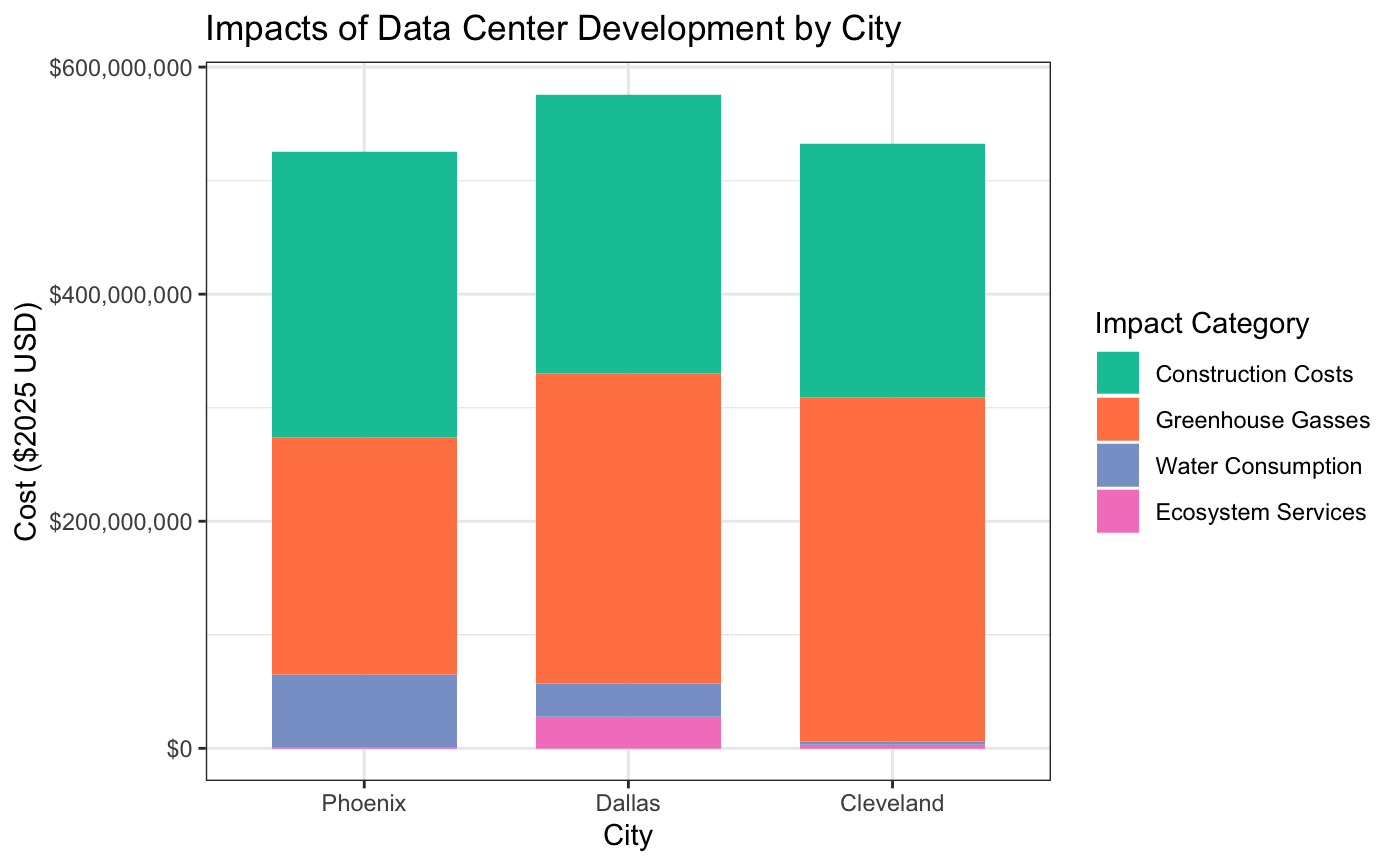
On the surface, this may still present an obvious "answer", but a deeper dive presents so much more insight.
- Environmental impacts are surprisingly large. Across all three sites, estimated environmental impacts over ten years exceed the initial construction cost of the facility.
- Greenhouse gas emissions dominate the results. In every scenario, greenhouse gas impacts represent the largest share of total environmental impact, suggesting that energy strategy is likely to be one of the most consequential decisions available to project developers.
- Phoenix's performance is driven primarily by its electricity mix. Despite being the hottest location in the analysis, Phoenix generates the lowest estimated GHG emissions impact because Arizona's grid is considerably less carbon intensive than those serving Dallas and Cleveland.
- Water impacts vary dramatically by geography. Water-related impacts in Phoenix are more than twenty times higher than those estimated in Cleveland, highlighting how location can matter as much as consumption itself.
- Not all environmental risks move together. Phoenix performs relatively well on greenhouse gas impacts but poorly on water impacts, demonstrating that optimizing one sustainability objective does not necessarily optimize another.
- Land impacts are highly dependent on what is being developed. Although all three locations require the same footprint, ecosystem-service impacts vary substantially because different landscapes provide different levels of ecological value.
- Current conditions play an outsized role in the results. The analysis reflects today's electricity grids, water conditions, and ecosystems. Those conditions may change considerably over the life of a long-term asset like a data center.
- The "best" location depends on what risks matter most. An organization concerned primarily with emissions may view the results differently than one focused on water stewardship, biodiversity, permitting risk, or community concerns.
The Next Steps
The analysis reveals opportunities and tradeoffs that were completely invisible in the original construction-cost comparison.
- What impacts should drive site attractiveness? Phoenix's advantage is largely driven by today's grid mix, making energy sourcing and future grid trajectories key variables in the investment thesis.
- Which environmental risks are most likely to become business risks in the near future? Water availability, energy costs, permitting requirements, and stakeholder expectations may evolve significantly over the life of the asset.
- How can project design improve long-term outcomes? Options such as water reuse, renewable energy procurement, and site selection may materially alter the impact profile before construction ever begins.
- Are there opportunities to reduce impacts without compromising business objectives? Previously developed sites, alternative energy strategies, and different cooling technologies may provide pathways to reduce risk while maintaining operational performance.
Rather than ending the conversation, impact accounting helps identify where further analysis could create value.
Better Decisions from Richer Information
Impact frameworks and accounting expands the discussion around what we value and how we make decisions.
Instead of focusing solely on upfront costs, we can begin evaluating long-term risks, dependencies, tradeoffs, and opportunities for improvement before capital is committed.
Sometimes the most valuable outcome isn't the answer itself.
It's recognizing the questions that were missing from the decision in the first place.