




A Different Read on Corporate Climate Progress

If you have been in sustainability for a while, the past year has felt like a turning point, seemingly in a negative way.
Policy support has been uneven between delays and rollbacks of policy. Funding feels like it has been pulled back even if the broader rhetoric doesn't say that. Sustainability programs have been scrutinized having to double down on justifications for the work in new ways or in front of new leadership. It would be easy to assume companies are slowly stepping back behind the scenes.
But these stories are just that, stories. Anecdotes. They capture the reality for a single company but do not tell us what the sustainability ecosystem is doing.
For that, we need data and looking at PwC’s latest State of Decarbonization report, the signal is actually quite different.
82% of companies held steady or accelerated their decarbonization timelines, even in a year full of disruption. At the same time, more companies increased ambitions than reduced them, and progress toward targets actually improved.
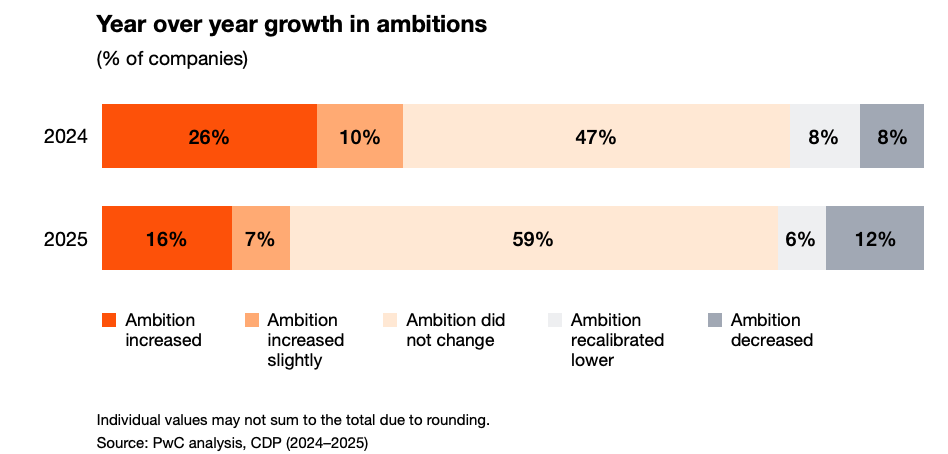
While you may interpret these findings in various ways, they are a clear signal that, even in periods of turmoil, sustainable action provides clear business value to those organizations fully investing in the opportunities to transform their next phase.
What’s actually changing
That is not to say that nothing has changed. What stands out in the report is not just that companies are continuing their efforts, but how those efforts are evolving.
The early years of corporate decarbonization were shaped by external drivers:
- investor pressure
- disclosure requirements
- net zero commitments
Companies are starting to evaluate decarbonization the same way they evaluate any other part of the business:
- Does it reduce cost?
- Does it improve resilience?
- Does it support growth?
And, in truth, the answer to these questions is a resounding "yes" in many cases. Companies investing in climate transition are seeing meaningful valuation premiums and revenue impacts, especially when those investments connect directly to operations or products. This is critical for the majority of sustainable action as it shifts from something a company is supposed to do to something that should be done because it increases business value.

Where the work is getting harder
At the same time, it is clear the next phase is not going to look like the last one.
A lot of early progress came from relatively straightforward moves:
- renewable electricity procurement
- basic efficiency improvements
- operational adjustments
Those levers are still in play for many (and if you haven't tackled them, you should! They save you money!), but they are no longer enough on their own.
The data reflects that shift:
- 69% of companies are now on track to meet Scope 1 and 2 targets
- but tracking and progress drop off significantly in Scope 3
This suggests that these win-win projects keep most companies on track while also saving money. But this new phase is, and was always going to be, the harder part. We now are moving from capturing obvious inefficiencies to making more complex operational and capital decisions.
Why this moment matters so much
It is easy to look at all of this and see friction. There is more complexity, fewer easy wins, and a higher bar for proving value. But there is another way to read what is happening.
If companies had pulled back under these conditions, it would suggest that earlier decarbonization efforts were still superficial. Instead, what we are seeing is clear persistence where companies are continuing, but they are becoming more selective, more analytical, and more tightly connected to how the business actually runs.
It suggests that decarbonization is no longer just something companies are doing because they feel they should. It is becoming something they continue because it holds up under pressure.
At the same time, this is the point where the gap between companies will start to open. Some will figure out how to connect decarbonization directly to operations, capital allocation, and product strategy. Others will continue to treat it as a parallel effort or pull back entirely. Those paths start to diverge quickly, and over time that divergence shows up in cost, resilience, and competitiveness.
One way to approach that is to move away from broad strategies and focus on concrete systems inside the business. Take a facility, an energy system, or a critical input and examine it closely.
- Where is the business exposed to cost volatility or supply disruption?
- What changes would reduce that exposure?
- Which of those changes also reduce emissions?
- Are there other environmental or social benefits that come from the action?
- Which ones improve returns?
PwC’s report does not suggest that all companies are on track to meet global climate goals, but it does point to something equally important. Corporate decarbonization efforts are proving more durable, and more economically grounded, than many expected.